CERN Uses Tiny AI Models Burned into Silicon for Real-Time LHC Data Filtering
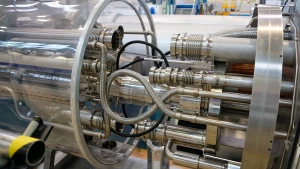
 CERN employs ultra-compact AI models physically embedded in silicon chips to filter massive LHC data streams in real-time.
Summary
CERN is addressing the challenge of filtering the enormous data volume generated by the Large Hadron Collider (LHC)—up to hundreds of terabytes per second—by using extremely small, custom artificial intelligence models physically burned into silicon chips like FPGAs and ASICs. Because storing or processing all raw data is impossible, a critical Level-1 Trigger system must discard 99.98% of events in under 50 nanoseconds. CERN's approach moves away from conventional GPUs, using highly optimized models compiled via the HLS4ML toolchain for ultra-low-latency inference directly at the detector edge. A distinctive feature is the heavy use of precomputed lookup tables in the hardware to achieve near-instantaneous outputs for typical signals. This 'tiny AI' strategy contrasts with the industry trend toward larger models, offering extreme efficiency and speed essential for current operations and future upgrades like the High-Luminosity LHC (HL-LHC).
(Source:TheOpenReader)